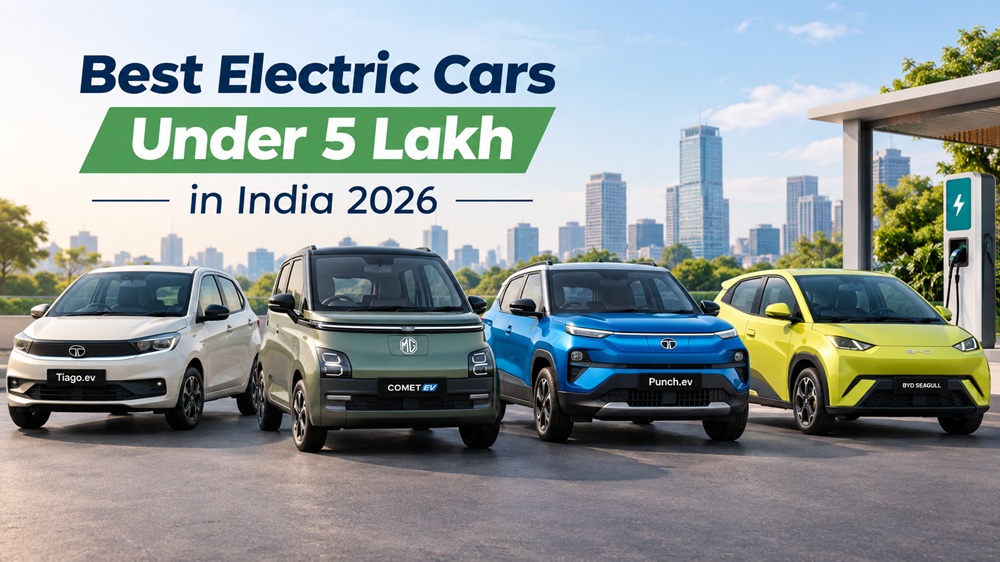
Best Electric Cars Under 5 Lakh in India 2026
Best Electric Cars Under 5 Lakh in India 2026 are becoming a more realistic search for budget-conscious buyers, but there is an important detail to understand before comparing prices.
In 2026, the ₹5 lakh threshold can be reached through Battery-as-a-Service (BaaS) plans offered on selected electric cars. Under BaaS, the vehicle’s upfront price is reduced because the battery is provided through a separate rental or subscription arrangement, with the buyer paying an additional per-kilometre charge.
This means a car advertised at below ₹5 lakh under BaaS should not be compared directly with a conventional EV whose ex-showroom price already includes the battery.
Among the current options, the Tata Tiago EV and MG Comet EV are particularly relevant for buyers searching for an electric car with an upfront price below ₹5 lakh.
Before comparing prices, buyers can also explore our guide to the best electric cars in India to compare models across different price ranges.
Are There Electric Cars Under ₹5 Lakh in India in 2026?
The answer depends on how the price is calculated.
If you mean the normal ex-showroom price including the battery, the Tiago EV and Comet EV should not simply be treated as conventional sub-₹5 lakh electric cars.
However, BaaS changes the upfront purchase figure.
Under this model, the battery is separated from the vehicle purchase price. The buyer pays a lower initial amount for the car and then pays a recurring battery-use charge, usually calculated on kilometres driven.
This is why selected EVs can appear below ₹5 lakh in advertisements.
| Electric Car | BaaS Upfront Price | Battery Charge | Best Suited For |
|---|---|---|---|
| Tata Tiago EV | From ₹4.69 lakh | From ₹2.60/km* | Small families and city commuters |
| MG Comet EV | From ₹4.99 lakh | BaaS terms vary by offer | Urban commuting and compact-city use |
*BaaS prices and terms are subject to finance-partner conditions, eligibility and manufacturer updates.
For the latest official Tata EV information, buyers can check the Tata Tiago EV official page.
For the MG Comet EV, specifications and ownership-programme details can be checked through the official MG Motor India Comet EV page.
1. Tata Tiago EV
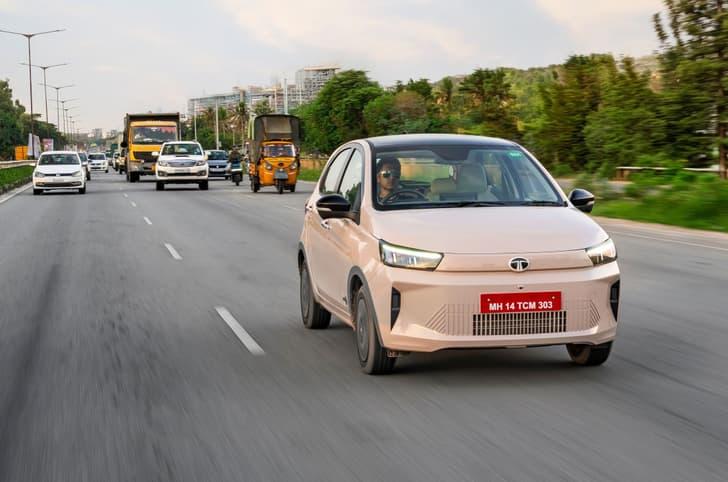
The Tata Tiago EV is one of the most relevant options for buyers searching for an affordable electric hatchback in India.
Tata currently offers the Tiago EV with different battery configurations and variants. The manufacturer’s current information lists a 24 kWh battery version with an ARAI-certified range of up to 285 km, while its BaaS programme applies to the Smart 19 kWh configuration under specified financing conditions. (Tata.ev)
Tata Tiago EV Price
The conventional Tiago EV price is higher than ₹5 lakh, but its BaaS structure can reduce the upfront amount.
The BaaS offer shown by Tata applies to the Smart 19 kWh version and is subject to financing conditions, usage assumptions and applicable statutory charges. (Tata.ev)
Therefore, buyers should not interpret the BaaS price as the complete on-road cost.
The final amount can include:
- Registration
- Insurance
- Road tax where applicable
- TCS
- Government charges
- Charging equipment
- Financing costs
- Battery-use charges
Tata Tiago EV Battery and Range
The current 24 kWh Tiago EV has an ARAI-certified range of 285 km, while Tata quotes an estimated C75 real-world range of around 205–215 km for this configuration. (Tata.ev)
Actual range depends on:
- Traffic
- Driving style
- Air-conditioning usage
- Passenger load
- Road conditions
- Weather
- Tyre pressure
Tata Tiago EV Features
Depending on the variant, the Tiago EV offers features such as:
- Automatic transmission
- Multiple drive modes
- Regenerative braking
- Connected-car technology
- Automatic temperature control
- Touchscreen infotainment
- Wireless Apple CarPlay and Android Auto
- Six airbags
- Electronic stability programme on applicable variants
- 360-degree camera on higher variants
- Rear parking sensors
Tata’s official specification page also lists features such as connected-car technology, 360-degree camera functionality and wireless smartphone connectivity on applicable variants. (Tata.ev)
Who Should Consider the Tiago EV?
The Tiago EV can suit buyers who want a relatively conventional hatchback format with greater emphasis on everyday practicality.
It may be relevant if you:
- Primarily drive within a city
- Want a small family EV
- Have access to home charging
- Want a five-seat hatchback
- Prefer a familiar hatchback design
- Want an EV that can handle regular urban commuting
Before purchasing, read our detailed guide to EV charging in India to understand home and public charging requirements.
2. MG Comet EV
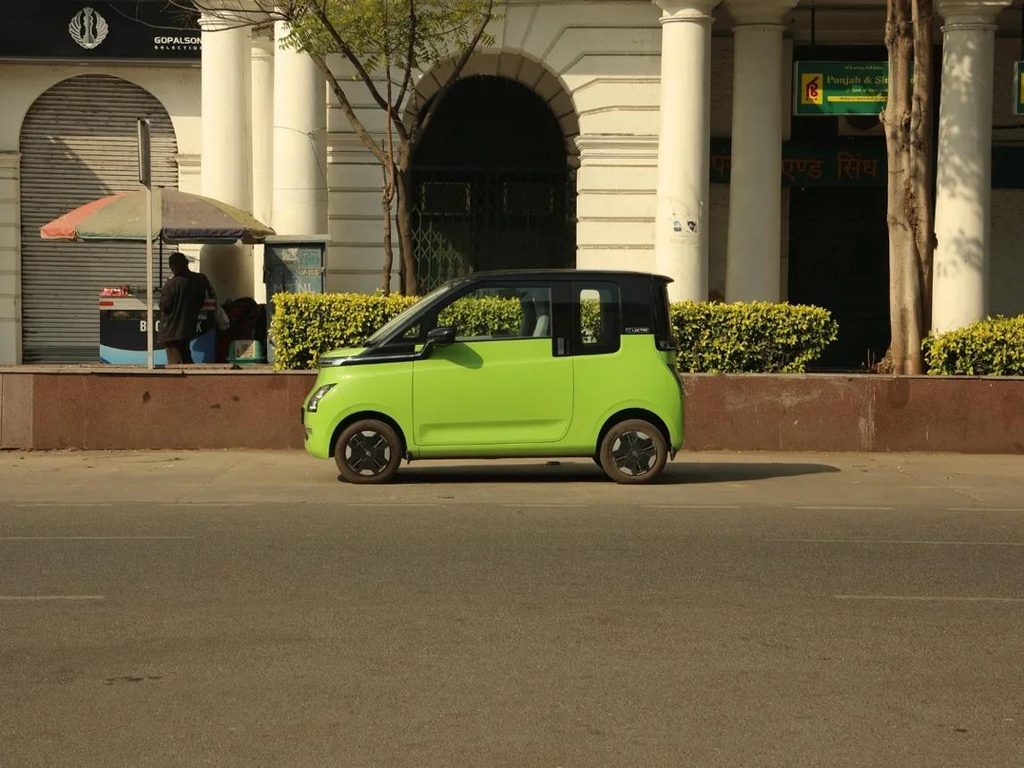
The MG Comet EV takes a different approach to affordable electric mobility.
It is a very compact four-seater designed primarily around urban driving. MG lists a 17.4 kWh battery, 42 PS of maximum power, 110 Nm of torque and an ARAI-certified range of 230 km. (MG Motor India)
MG Comet EV Price
The MG Comet EV can be offered through a BaaS ownership programme that lowers the upfront vehicle price.
The manufacturer’s BaaS material has listed the introductory vehicle price at ₹4.99 lakh, with battery rental charged separately under the applicable programme terms. (MG Motor India)
This means the ₹4.99 lakh figure should not be treated as the complete ownership cost.
Buyers should obtain a current quotation from an authorised MG dealer because BaaS rates, finance arrangements and programme conditions can change.
MG Comet EV Battery and Range
The MG Comet EV uses a 17.4 kWh battery and has an ARAI-certified range of 230 km. MG lists 42 PS of power and 110 Nm of torque. (MG Motor India)
Its compact size makes it particularly relevant for urban driving, parking in tight spaces and short daily commutes.
MG Comet EV Features
Depending on the variant, the Comet EV offers features including:
- Digital instrument cluster
- Touchscreen infotainment
- Wireless Apple CarPlay
- Wireless Android Auto
- Connected-car technology
- Automatic transmission
- Reverse parking sensors
- Electronic stability control
- Hill-hold control
- Digital key on selected variants
For the latest equipment and variant information, buyers should refer to the official MG Comet EV specifications.
Who Should Consider the MG Comet EV?
The Comet EV is primarily designed around urban mobility.
It can be relevant for buyers who:
- Drive mostly inside cities
- Frequently use narrow or congested roads
- Need an easy-to-park vehicle
- Have a short daily commute
- Usually travel with one or two passengers
- Do not regularly need a large boot
Its four-seat layout and compact dimensions should be considered carefully by larger families.
Tata Tiago EV vs MG Comet EV
The two cars target somewhat different types of buyers.
| Feature | Tata Tiago EV | MG Comet EV |
|---|---|---|
| BaaS availability | Yes, applicable variant | Yes, applicable programme |
| Battery | Multiple configurations | 17.4 kWh |
| Claimed range | Up to 285 km, depending on version | 230 km |
| Seating | 5 | 4 |
| Body style | Hatchback | Compact urban EV |
| Primary use | City + everyday practicality | City commuting |
| Charging | Variant dependent | AC charging |
| Family practicality | Higher | More limited |
The Tiago EV offers a more conventional hatchback format and five-seat configuration, while the Comet EV focuses more strongly on compact urban transportation.
The right choice depends on driving requirements, family size, charging access and the total cost of the chosen BaaS arrangement.
You can also read our Tata Tiago EV vs MG Comet EV comparison for a more detailed comparison.
What Is BaaS and How Does It Work?
Battery-as-a-Service, or BaaS, separates the battery cost from the upfront vehicle purchase.
Instead of paying the complete vehicle-and-battery price at the beginning, the customer pays:
Vehicle price + battery-use charge
The battery charge may be calculated according to kilometres driven.
For example, if a plan charges ₹3.20 per kilometre and a driver travels 1,000 km in a month:
1,000 × ₹3.20 = ₹3,200
This is only an illustration. The actual BaaS rate and contract conditions depend on the manufacturer and financing partner.
Tata’s current official page specifically notes that its BaaS price applies to the Smart 19 kWh configuration under specified usage and financing assumptions and excludes several government and ownership costs. (Tata.ev)
The buyer should therefore compare the total cost of ownership, rather than focusing only on the headline upfront price.
BaaS vs Conventional EV Purchase
| Factor | BaaS EV | Battery-Included EV |
|---|---|---|
| Upfront price | Lower | Higher |
| Battery payment | Recurring | Included in purchase |
| Per-km charge | Applicable under BaaS terms | Normally not applicable |
| Initial affordability | Higher | Lower |
| Cost calculation | More complex | Simpler |
| Long-term comparison | Requires usage calculation | Easier to estimate |
BaaS can reduce the initial purchase amount, but buyers should calculate the cumulative battery charges over their expected ownership period.
What Should You Check Before Buying an EV Under ₹5 Lakh?

1. Check the Complete On-Road Price
Do not assume the advertised BaaS price is the final amount.
Ask the dealer for a complete quotation covering:
- Vehicle price
- BaaS charges
- Insurance
- Registration
- Road tax where applicable
- FASTag
- Accessories
- Finance charges
- Other statutory costs
2. Calculate Your Annual Driving Distance
The per-kilometre battery charge makes annual usage particularly important.
Someone driving 500 km per month and another person driving 2,000 km per month can have significantly different battery-use costs.
Calculate your expected annual kilometres before choosing a BaaS plan.
3. Check Home Charging Availability
Home charging can make EV ownership significantly more convenient.
Before purchasing, check whether you have:
- Dedicated parking
- Suitable electrical supply
- Permission for charger installation if living in an apartment
- Safe cable routing
- Public charging nearby as a backup
The Bureau of Energy Efficiency (BEE) provides official information on EV charging infrastructure, state EV policies and public charging guidelines. Buyers can refer to the BEE electric mobility resources. (BEE)
4. Compare Charging Costs
Electricity is another important part of EV running costs.
According to BEE, home-charging cost can be estimated using:
Battery capacity × applicable EV electricity tariff
However, actual charging cost varies by state tariff, charging losses, battery size and whether the vehicle is charged at home or at a public charging station. (BEE)
Read our detailed EV charging in India guide before purchasing.
5. Check Battery Warranty and BaaS Terms
Battery warranty and battery-rental terms are not the same thing.
Read the agreement carefully and check:
- Battery warranty
- Subscription duration
- Minimum usage requirements
- Per-kilometre rate
- Rate revision conditions
- Early termination rules
- Transfer conditions if the car is sold
- Battery replacement conditions
- Damage liability
6. Consider Maintenance Costs
EVs have fewer mechanical components than conventional petrol or diesel vehicles, but they still require maintenance.
Consider:
- Tyres
- Brakes
- Suspension
- Air-conditioning
- Fluids
- Software
- Scheduled servicing
You can compare electric car maintenance costs before purchasing.
What About EV Charging Infrastructure in India?
Charging availability is an important part of the EV buying decision.
BEE states that adequate charging infrastructure is a key requirement for wider EV adoption and identifies itself as the central nodal agency for public EV charging infrastructure at the national level. (BEE)
Buyers should therefore investigate charging availability around:
- Home
- Workplace
- Regular commute
- Shopping areas
- Highways used frequently
- Long-distance travel routes
The availability of chargers can differ significantly between cities and states.
Is an EV Under ₹5 Lakh Good for Highway Driving?
A low-cost city EV does not automatically become a suitable highway vehicle.
Before using a small EV for frequent intercity travel, consider:
- Real-world highway range
- Charging infrastructure
- Charging time
- Vehicle size
- Boot capacity
- Passenger comfort
- Highway performance
- Roadside assistance
The MG Comet EV is particularly compact and has four seats, while the Tiago EV provides a more conventional hatchback format.
For frequent highway travel, buyers may want to compare larger EVs by increasing their budget.
How Much Does an EV Under ₹5 Lakh Really Cost?
The headline price is only the starting point.
For a BaaS EV, your ownership calculation should look like:
Total cost = Upfront vehicle cost + battery-use charges + electricity + insurance + maintenance + registration and other applicable costs
For example, at ₹2.60/km, 10,000 km of driving would represent ₹26,000 in battery-use charges.
At ₹3.20/km, 10,000 km would represent ₹32,000.
These are simple illustrations and do not include electricity, insurance, maintenance or other ownership expenses.
BEE also notes that EV total cost of ownership should consider charging, maintenance and operating costs rather than only the initial purchase price. (BEE)
Who Should Consider a Budget EV in 2026?
An affordable electric car can be relevant for buyers who:
- Have a predictable daily commute
- Can charge at home
- Mostly drive in urban areas
- Want to reduce petrol or diesel usage
- Prefer automatic driving
- Have access to suitable charging infrastructure
- Understand the BaaS payment structure
Buyers with long highway commutes, large families or limited charging access may need to consider larger EVs or other powertrain options.
Common Mistakes to Avoid
Looking Only at the ₹5 Lakh Price
Always check whether the advertised price includes the battery.
Ignoring the Per-Kilometre Battery Charge
Calculate the BaaS cost using your expected annual kilometres.
Forgetting Charging Costs
BaaS charges and electricity costs are separate.
Not Checking the Contract
Read the complete BaaS agreement before signing.
Choosing an EV Without Home Charging
If you cannot conveniently charge at home, investigate nearby public charging options before buying.
Comparing Cars Only by Range
Range is important, but so are seating capacity, boot space, charging speed, service support, safety equipment and real-world usability.
Best Electric Cars Under 5 Lakh in India 2026: Quick Summary
The ₹5 lakh electric-car category is unusual in 2026 because the headline prices are primarily created through BaaS arrangements.
Tata Tiago EV: The current Tata Tiago EV range includes a 24 kWh version with an ARAI-certified range of up to 285 km. Tata also lists BaaS pricing for the Smart 19 kWh configuration under specified financing and usage conditions. (Tata.ev)
MG Comet EV: The Comet EV uses a 17.4 kWh battery and has an ARAI-certified range of 230 km. MG has offered BaaS pricing that lowers the upfront vehicle price, with battery rental charged separately under the applicable programme. (MG Motor India)
For buyers who can increase their budget, explore our electric car buying guide for a broader comparison.
FAQs
Which is the cheapest electric car under ₹5 lakh in India in 2026?
The Tata Tiago EV and MG Comet EV can both appear below the ₹5 lakh upfront threshold through BaaS arrangements. The exact price depends on the applicable variant, financing programme and manufacturer offer.
Is the ₹4.99 lakh MG Comet EV price the final price?
No. The BaaS price represents the vehicle’s upfront component. Battery rental and other applicable ownership costs are separate. MG’s official BaaS documentation states that battery rental, charging costs and applicable taxes or fees are handled separately according to the programme terms. (MG Motor India)
Is the Tata Tiago EV available under ₹5 lakh?
Tata currently lists a BaaS price for the Smart 19 kWh version, subject to financing and usage conditions. The manufacturer states that the displayed BaaS price excludes government statutory levies, insurance and other applicable charges. (Tata.ev)
What is BaaS in an electric car?
BaaS stands for Battery-as-a-Service. Instead of paying the complete battery cost as part of the upfront vehicle price, the customer pays a separate battery-use or rental charge according to the applicable agreement.
Is BaaS cheaper than buying an EV normally?
BaaS can reduce the upfront purchase amount, but whether it reduces the overall cost depends on annual kilometres, battery charges, electricity costs, contract terms and ownership period.
Which EV is suitable for a family of five?
The Tiago EV has a five-seat configuration, while the MG Comet EV has four seats. Buyers should check the exact variant specifications and available passenger space before purchasing.
What is the range of the MG Comet EV?
MG lists a 230 km ARAI-certified range for the Comet EV with its 17.4 kWh battery. (MG Motor India)
What is the range of the Tata Tiago EV?
Tata’s current 24 kWh Tiago EV has an ARAI-certified range of up to 285 km, with an estimated C75 real-world range of around 205–215 km for that configuration. (Tata.ev)
Final Takeaway
Best Electric Cars Under 5 Lakh in India 2026 are primarily a BaaS story rather than a conventional sub-₹5 lakh electric-car segment.
The Tata Tiago EV and MG Comet EV can bring the upfront vehicle price below ₹5 lakh through battery-service arrangements, but buyers must account for the additional battery charges and other ownership expenses.
The Tiago EV offers a five-seat hatchback format and multiple battery configurations, while the MG Comet EV focuses strongly on compact urban mobility.
The most useful comparison is therefore not simply:
“Which EV costs less than ₹5 lakh?”
Instead, buyers should ask:
“Which EV gives me the right combination of upfront price, battery charges, charging convenience, range and everyday practicality for my driving pattern?”
Disclaimer
Prices, BaaS charges, specifications, range figures and manufacturer policies can change. Always confirm the latest ex-showroom price, BaaS terms, on-road price, warranty and applicable taxes with the authorised manufacturer or dealer before purchasing. This article is for general informational purposes and should not be treated as personal financial or purchasing advice.